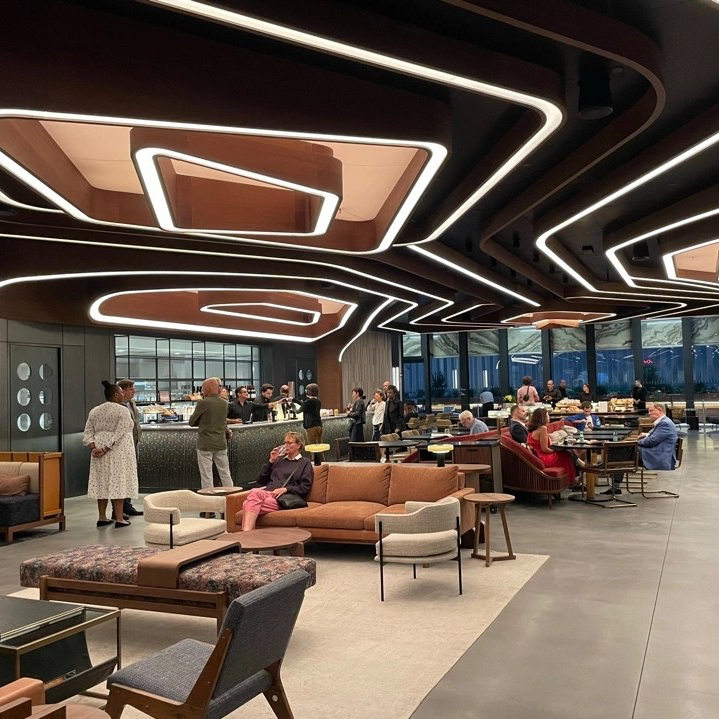
The Perelman Performing Art Center’s restaurant Metropolis on the public opening night
At 6.45pm the 1 Train was already quiet; there are only seven of us in the carriage at Cristopher Street Station. It was clear that Lower Manhattan’s “daytime population” had migrated home.
Five stops later, I emerge from the Fulton Centre and behind the flocking tourists, the temporary night dwellers of the World Trade Centre, the pearly-white structure of the new Perelman Art Centre (PAC) stood glowing in the evening light. Its massive marble-clad façade starkly contrasted the tall glass skyscrapers behind it.
Named after billionaire Ronald Perelman, who donated $75 million to the project, this building houses three reconfigurable theatres for up to 950 guests, an outdoor terrace and a fine-dining restaurant, all decked in plush sofas and sleek LED lights.
PAC NYC marks the newest addition to the 20-year-long Master Plan to rebuild the World Trade Centre. For many New Yorkers, the neighbourhood is a constant reminder of the trauma of 9/11. However, the Lower Manhattan Development Project, according to its leaders, aims to introduce a newvibrant cultural hub for residents and workers.
“I don’t have to go far anymore,” said Alexandra Makarevich,a clerk at 1WTC, during the public opening on Tuesday night. “It brings theatre people down south,” added Ann Rosenthal, a long-time theatre producer. The centre’s location is convenient for Brooklyn and Queens natives who wouldotherwise commute to midtown to see some theatre.
Over the last two years, the arts and entertainment sector suffered as the pandemic eradicated $1.5 billion in wages from its workers. Just two months ago the Public Theatre, renowned as the birthplace of “Free Shakespeare”, had to lay off 19% due to increased costs and a sharp decrease in its audience.
“It’s actually harder than the pandemic times,” said choreographer Robbie Saenz de Veteri, who participated at the inauguration show. “It’s our job to remind the public of the human beings that keep these spaces alive”.
However, not everyone is celebrating.
The exorbitant $500 million spent on the building, double theoriginal 2016 budget, raised questions about the ethos and purpose of PAC NYC. “The whole redevelopment has become about ostentatious luxury real estate,” said Todd Fine, historian and President of the Washington Street Advocacy Group.
After 15 years of seeking more funding and a dramatic change of architects in 2014, PAC NYC was finally completed thanks to the hefty donation made by former Mayor Mike Bloombergin 2016, who contributed $130 million to the project. “Bloomberg bails it out constantly” said Fine, who questions the public value of the centre if it was funded and named after billionaires. “This is the prime example of the privatisation of the government”.
One of the core values of PAC NYC, according to its website,is “to make our spaces and program inclusive and accessible to all”. The “Pay-What-You-Wish” ticketing system during the inauguration week and a variety of performances including an “Arts Community Day” reflect this commitment. However, Fine remains sceptical: “Let’s be honest, it’s a business. How will they treat it as a public good?”.

