This article was featured on N+2 a literary magazine created by students of the Columbia Journalism School. Read more here.
In 2021, Emma Copsey, a 21-year-old from Japan, was prescribed an oral contraceptive pill to treat acne. Copsey had tried all sorts of skincare regimens with dermatologists, and the pill seemed like a reasonable solution to try next. Like many teenagers, already having to adapt to the rapid bodily and emotional changes of puberty, Copsey felt insecure about her acne. “There were periods in my life where it became unbearable,” she told me.
That summer, her mom, Kazuyo, had found a doctor who held online consultations to prescribe the pill to women. Kazuyo had seen her daughter struggle with acne and thought she had nothing to lose in trying it out. But the appointment was nothing like the consultation Kazuyo and Emma had imagined. The doctor, located in Japan, barely looked at Emma. He didn’t ask questions about her lifestyle or any underlying health conditions. It was like he was just waiting to pitch the pill and for her to agree, Emma said. At the end of the appointment, Kazuyo, aware of the infamous risk of blood clotting from the pill, asked the doctor about this possibility. In response, according to Kazuyo, the doctor said there was a “zero percent chance” of any clots forming. Emma would not need regular checkups, he added. She was given a month’s supply of the Japanese equivalent of a combined birth control pill, called Yaz, and promptly dismissed.
For a while, everything was fine. Emma’s skin cleared up. Emma had a history of migraines, but these didn’t worsen when she got on the pill, initially. Other than these, and minor changes in mood, she felt good.
In the fall, Emma moved to Florence for a year abroad. One night, in her high-ceilinged apartment, whilst scrolling through social media, her arm started to feel tingly. She shrugged it off; she thought the numbness was probably caused by the hours spent scrolling on the app with her head propped up by her arm. It was only when she went for a drink of water that she became concerned. By this point, her face had also started to feel numb. When she took a sip, she found she was unable to keep it inside her mouth. It dribbled down her face as if she were a child.
She wanted to call her mother, but it was the middle of the night in Japan. She decided to text her boyfriend, who was in London but her hands just hovered over the phone. At that moment, as she stared in disbelief at the blank screen, she realized she had lost the ability to speak. She looked in the mirror and saw that one side of her face was frozen. Emma thought she knew what was happening to her; her dad had had a stroke a few years earlier, and it looked a lot like this. She wanted to call an ambulance but couldn’t find the words to speak. Trapped in her own head, she started shaking uncontrollably. This was followed by a dull throbbing pain behind her ear.
After about twenty minutes, when she was able to speak again, she managed to leave her apartment and get help. Her neighbor called an ambulance to take her to the emergency room. As she sat at the back of the jittery vehicle, going through the narrow cobblestoned streets of Florence, Emma still couldn’t fathom what had just occurred. “How could it happen to me when I was so young?” she asked herself.
When Kazuyo found out, she told me she “cried out loud in despair.” Helpless and stuck on the other side of the world, she panicked at the thought of her daughter trying to fend for herself alone.
In the emergency room, the doctors didn’t have an MRI to confirm a diagnosis of a stroke. Considering her young age, they thought she might have instead experienced an anxiety attack. A few days later she flew to London to get the necessary tests done. It turned out that indeed it was a stroke. Called a transient ischemic attack, it had happened in the part of her brain that controlled speech, hence the temporary and sudden loss of it. When she told them she had a history of migraines with aura, the doctors told her she should have never been on the birth control pill in the first place. Patients like her are six times more at risk of getting a stroke.
Emma had no idea.
The history of birth control in the literal sense, is a longer one than most people think. Since the beginning of time, women have tried all sorts of ways to stop falling pregnant. As early as 1850 BC, women in Egypt were using crocodile dung as contraception, believed to kill sperm, because truth be told, having a child has always been both expensive and dangerous.
But the history that led to women having a safe and legal birth control method is a much more recent one. Specifically, the journey of the pill as the first hormonal contraceptive, has at many points, been tied into the complex web of other social issues notably the prominence of the Christian right throughout the 19th century, persistently butting heads with Second-wave feminists, pushing for access to safe birth control. It’s never been a standalone issue, and the path to its long-awaited conception is rarely linear, which is why when the first pill was approved by the FDA in 1960, it marked one of the greatest moments in the history of female reproductive rights.
The birth of the pill gave women greater independence over their reproductive anatomy, being able to delay or pause their maternal duties as they pleased. In her book, The Moral Property of Women, Linda Gordon states that the pill became “a tool for autonomy, freedom and higher aspirations.” Soon enough, the pill’s powerful impact became clear. Just five years later, American women made up half of the global population on the pill: around six and a half million women.
In the ‘90s, the pill took on a new role. According to a paper in the American Journal of Public Health, written by Professor Elizabeth Siegel Watkins at the University of California Riverside, it became a “lifestyle drug” to treat conditions at the margin between lifestyle wishes and health needs. The pharmaceutical companies began advertising campaigns to publicize the pill for its powerful effects in treating other medical conditions such as acne, polycystic ovarian syndrome (PCOS), and endometriosis. “It’s not uncommon in medicine for drugs to be used for one purpose, but then to find that they have a secondary purpose that might even be more useful,” said Siegel Watkins.
According to Dr Sheila Radhakrishnan, my gynecologist, the pill became the first port of call to treat these conditions because of the powerful effects that combining synthetic estrogen with progesterone had on women’s menstrual cycles. With PCOS for example, uncontrolled levels of estrogen lead to hormonal, metabolic, and reproductive disturbances like acne, weight gain and painful periods. The pill can help control irregular ovulation, through its release of artificial hormones that produce a much lighter, more regular and less painful period. Oftentimes, women will also combine the pill with other drugs, such as anti-androgens (predominantly testosterone blockers), that regulate the production of sebum which causes acne.
In 2006, Bayer Pharmaceuticals began to publicly advertise its birth control pill, Yaz, as a treatment for premenstrual dysphoric disorder and acne, with its slogan ‘Beyond Birth Control.’ By 2009, it became the best-selling oral contraceptive in the US. Today, according to the Guttmacher Institute, only 42% of women use the pill exclusively for contraceptive reasons.
But a simple Google search will reveal the staggering reality of some of the pill’s implications. Bayer’s Yaz has three different web pages where people can find information on how to file a lawsuit against this pharmaceutical conglomerate. In fact, as of 2023, Bayer paid over $850 million to some of its customers, to settle thousands of lawsuits related to cases of pulmonary embolisms and strokes caused by Yaz. According to the legal writer Christie Nicholson, Bayer has not claimed liability for any of these cases, rather asking many of the plaintiffs to sign agreements that they weren’t legally responsible for these injuries.
These extensive legal cases might be the glaringly obvious proof that women are limited in their reproductive choices, leading them to pursue the least unsatisfactory option from an already limited selection. Siegel Watkins claims that pharmaceutical companies have continued to sell these decade-old pills which use the same technology, rather than investing to develop better medications for women.
Women have grown so accustomed to the risks and side effects associated with the pill, that there is a common internalized stigma that we are just supposed to deal with them. Dr. Eleonor Pam, President of the Veteran Feminists of America, who was vocal during the first decades of the pill said, “It forced us to examine and try to balance the freedoms we were winning because of it versus the liabilities, or potential liabilities that argued against its use.” The pill was certainly a step in the right direction when it came to female bodily autonomy, but for some, it came at the expense of dangerous health risks. Feminists, part of the D.C. Women’s Liberation movement, went as far as to argue that the pill was another example of the patriarchy trying to control women. The pill was being researched and manufactured in a male-dominated industry for women who were generally absent from these spaces. According to Dr. Pam, this symbolized, “another act of oppression.”
Given the constant over-prescription of the pill for “off label” use to treat all kinds of issues from acne to anemia, many serious conditions are still misunderstood, cast into the shadows of medical research. As a result, women who seek more options to treat their complex conditions are often lost in the healthcare gap.
When the doctors confirmed Emma Copsey’s stroke, they also discovered that she had a hole in her heart, a condition known as Patent Foramen Ovale, which she didn’t know she had. In some ways both Copsey and her mother think the stroke was a blessing because they found out she had this condition and were able to treat it through an operation the year after. Although it remains unclear, the heart condition which causes blood to flow improperly in the heart may have exacerbated the risk of clotting and thus stroke.
As a result, Emma Cospey immediately stopped the pill. Unsurprisingly, all her acne came back within a couple of months and it was just as bad as before. “It made me feel very defeated,” she said. Copsey went to another doctor, this time in the UK, and once again, the pill came up as an option.
“I had a stroke to try to fix my acne,” she said with frustration. Revisiting options that Copsey had already tried, made her feel like there was no hope in fixing the problem. Given her fear of taking any prescribed oral medication, she decided to try applying topical products again. Initially, she was given a retinol product, a common treatment for patients with acne, but the harshness of the solution made her flare up even more. Her face burnt in pain for several weeks, she said. So she stopped. It was only when Copsey spoke to a doctor in Japan that she seemed to have found a solution that worked. She was given a light concentration of Benzoyl Peroxide, a topical treatment given to patients with bad acne. However, the medication wasn’t available in the UK, so she would top up her supply when she traveled to Japan.
The lack of self-esteem because of acne began to affect pockets of Copsey’s personal life. She rejected or canceled dates because she didn’t have the confidence to show her face to strangers. “I didn’t feel like I was good enough for that,” she said. Copsey became terrified to go out in public without makeup, even just to her local deli nearby. She also became more observant of other people’s skin texture, comparing it obsessively to hers. This behavior started as early as in middle school, when one time a friend naively asked her what it was like to have acne. She remembered how taken aback she was that a friend could ask her such an insensitive question.
Later, at one point in her early adolescence, she developed Dermatillomania, which involves intense skin picking, often done as a stress coping mechanism. Naturally, it made her skin even more inflamed. It started off as her obsessively trying to pick or scratch at her acne, then it progressed to picking skin from other parts of her body, like her back. This went on for years until she forced herself to stop before going to university.
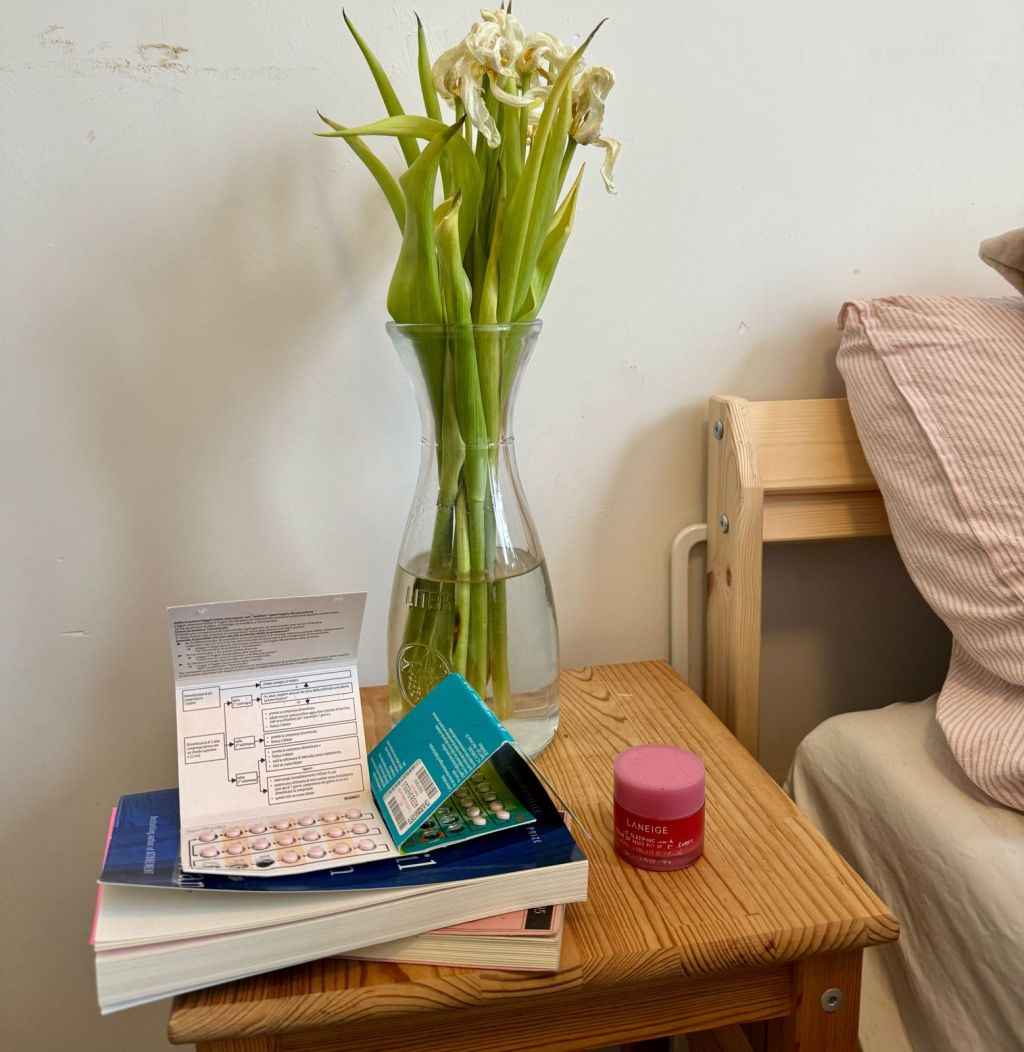
The birth control pill has the tendency to become your best friend. I know this because Yaz became my best friend for a while too. She’s tiny and pink, encased in neat little rows in a cardboard pouch with a drawing of an endearing sunset on it. She’s discreet, you can take her anywhere. She fits in your purse on a night out, next to your lip-gloss. She’s the first thing you see in the morning on your bedside table, serving as a daily reminder that you rely on her to feel and look better. But after a while, like with some friends, the relationship changes. She can start to feel like a toxic ex, you get tired of feeling dependent on her, but simultaneously you get stuck in a cycle you can’t escape; you need her because you have no other option.
Acne consumed my life for over seven years. For a large majority of that time, I didn’t know that acne was just the mild symptom of a bigger problem. I had been on antibiotics on and off for two years to try to get rid of it. My gut was ruined as a result, and I developed some food intolerances. None of my family members experienced any form of acne so I felt rather alone and confused. After many different dermatological visits in fancy studios, where I was prescribed tiny creams with impossible names to pronounce, my mother thought it was time for me to have a proper hospital appointment.
In 2019, I was put on Yaz, because it felt like a more sustainable solution than antibiotics. Initially, I felt really cool taking it because I wanted people to think I was having lots of sex. Quickly, I stopped having periods and my acne slowly cleared up. To my dismay, my breasts did not get bigger. A year in, at the height of the pandemic, I started getting debilitating migraines every other day. They were so bad the only way to ease the pulsating throbbing in my head was to sit in a dark and silent room. Eventually, it got to a point that these migraines were disrupting my studies and as a result, I had to get accommodations from my university.
It continued to get worse, so I called my general doctor at my local clinic. “You need to stop it immediately, you might be at risk of getting a stroke,” my doctor said. I could tell she was panicking. This seemed surreal. No one had told me that at 20 years old, I could be at risk of having a stroke caused by an oral contraceptive. So, I stopped and within 3 months all the acne came back, but it was so much worse. This time it had plagued my entire face, red and swollen like a huge rash. It even hurt to smile.
Hiding under pounds of makeup, I grew depressed. I remember one time I was standing in Rymans, a stationary store in London, waiting to pay at the till and I started profusely hyperventilating at the thought of the cashier seeing my face. So I left the shop. Thinking the problem might be worse than just spots, I went for an internal gynecological scan, and the doctors told me I had PCOS, a condition that can cause infertility, and which was most likely causing the acne.
In the US almost six million women struggle with PCOS, the number one cause of infertility. But according to the World Health Organization, 70% of cases are undiagnosed globally. The pill is one of the only medications that can regulate it, or so the doctors said.
I had always dreamed of being a mother and suddenly I was questioning whether I could ever become one.
The idea of having to go on the pill again, loaded with synthetic hormones which had almost caused me a stroke, terrified me. At the same time, my self-confidence had crumbled with acne, so I was stuck in a vicious cycle. I didn’t want to rely on this unsustainable medication that also altered my mental health, but I had no choice if I was to try and regulate the PCOS and clear the acne.
The healthcare gap isn’t just a national crisis, it’s a global one and it’s still an issue today. Earlier this year, the World Economic Forum released a report demonstrating the degree to which women are at a disadvantage in the healthcare system, no matter where or who they are. “For every one woman diagnosed with a health condition, roughly four go undiagnosed,” stated the report.
The report argued that from an economic standpoint, narrowing the healthcare gap would bring enormous benefits, as a better quality of life for billions of women would mean more of them being able to successfully contribute to the economy. Globally, women spend one-quarter of their lives in poor health and, according to the report, healthy women could contribute a staggering $1 trillion more to the economy.
Researchers identified two primary ways in which women are poorly served by the medical system. As Maya Dusenbery explained in her book Doing Harm: The Truth About How Bad Medicine and Lazy Science Leave Women Dismissed, Misdiagnosed, and Sick, the first way is that doctors continue to dismiss and ignore women’s pain, treating it as a byproduct of the disordered female anatomy. She wrote, “Either women’s reproductive functions are pathologized as innately abnormal – in which case any symptoms they bring are ‘normal’ – or else it is claimed that they’re normal, so if they cause symptoms, it’s only because an individual woman’s response to them is abnormal – she’s just especially sensitive or overreacting. In short, either all women are sick or some women are crazy.” This could be why, for example, endometriosis, a condition that affects one in ten women and which is characterized by severe menstrual cramps and bleeding, can take up to seven years to be diagnosed.
The other major gap in medical treatment for women is in research. Women’s bodies, and the ailments that afflict those bodies, have historically not been studied nearly as much as men’s bodies and sicknesses. This has taken many forms. One is that for decades the standard subject for medical research was the male, rather than female, body. According to Dr Caitlin Carlton, an OBGYN completing a fellowship at Albany Medical College, females have historically been perceived as less preferable unstable research subjects because of their menstrual cycles: The changes in their hormones were thought to make their bodies too difficult to study. According to Jamie White, who is a women’s health director at a government affairs consulting company, said even in pre-clinical trials, studies are done mostly on male vertebrates. As a result, conditions that affect both men and women, like cardiovascular disease for example, may have skewed results, impacting the following stages of research and unfairly misrepresenting females’ needs. Females have often been treated as “small men,” because they are perceived as the same as men, just with a smaller BMI, when in actual fact, there’s much more that sets them apart from men. As a result, White said, “we still don’t have the data sets to even understand female biology in the first place.” However, this theory was recently disproven, explained White, because males also go through fluctuating hormone cycles. Nonetheless, this discovery wasn’t enough to change how trials are conducted. Things like blood pressure research are still conducted on a predominantly male population, but “we know enough to know that you can’t just apply things like that across the board,” said Dr Carlton.
A great example of unequally applied research is the case of heart disease. Over the past ten years, heart disease in women has been increasing, becoming their number one killer in the U.S. Yet in 2023, only 30% of subjects studied for heart disease were women, despite the fact that they are twice as likely than men to die of a heart attack. Treatment for heart disease has predominantly been tested on middle-aged men, so women often fail to meet the criteria expected at clinical trials because their symptoms are different from those established by the male subjects studied. If the standard for detecting heart problems has always been based on the typical male symptoms, then it makes sense that just five years ago, almost 50% of women failed to recognize their symptoms of a heart attack.
Now, it’s been 30 years since the NIH established a policy that encouraged researchers to include females in their studies. But Sarah Temkin, associate director for Clinical Research at NIH, said that inclusion is not enough if analysis of these research findings is still not taking into consideration sex as a changing biological variable. “Clinical research is not the same thing as designing clinical research that is attuned to the health needs of women. The future of women’s health research is making sure that we’re asking questions that are relevant to the health needs of women,” said Temkin.
But research on women’s health cannot be done without funding. According to a paper written by Dr Arthur Mirin in 2022, a huge disparity between designated funding for female versus male-dominant diseases exists. The paper, titled Gender Disparity in the Funding of Diseases by the U.S. National Institutes of Health (NIH) found that across the board, female-dominant diseases are underfunded, whereas male-dominant diseases are overfunded. Only one male-dominant disease, liver cancer, was found to be underfunded. Whereas for female-dominant diseases, the majority were found to be underfunded. For example, chronic fatigue syndrome, which affects 75% of women in the US, was found to be the least funded disease of those in the study.
The numbers of this study speak to this fact. In 2019, funding, given by the NIH, for research on endometriosis, a condition that affects 190 million females globally, was supposed to be worth $71 million, but it was found that only $13 million was provided that year. Without funding, research into treatment innovation cannot be done. Doctors end up falling back on the same few treatment options, like the contraceptive pill, to treat women’s conditions. For example, in her book, Dusenbery called the birth control pill a, “wait-and-see Band Aid,” because it was designed to suppress and mask symptoms by suppressing menstruation. “Many general gynecologists will offer hormonal birth control as a first option. But while it can help minimize symptoms in some patients, it’s just a stopgap measure […]. Other hormonal treatments essentially throw the body into menopause, with a host of significant side effects,” she wrote.
Because of these limited options for treatment, women have had to accept a certain level of side effects in exchange for the results of medication — in the case of the pill, the guarantee of reliable contraception to avoid pregnancy, or the artificial lighter period that eases PCOS and endometriosis symptoms. So, women rely on the pill, which the medical industry has used to its advantage. As a result, a vicious cycle has formed. “Since there aren’t alternatives, you are forced to accept imperfect options and because you accept these options there is less pressure to produce alternative better options,” explained Dusenbery. Reflecting on what has changed since her book came out in 2017, Dusenbery said there has been little progress in contraception innovation because, “the superficial diversity of options reduces the sense of urgency towards costly contraceptive innovation.”
It’s not just female patients who have been discriminated against in their care, but also those who advocate for them. Dusenbery, who dedicated a large part of their lives to advocating for women’s reproductive rights, also experienced mild discrimination in a few instances. Right after college, Dusenbery worked at a reproductive health advocacy non-profit. She started writing for a feminist blog called Feministing, which is when she decided to pursue writing full time and become a journalist. Overall, her experience whilst publishing her recent research has been rewarding, but she recalls instances where people undermined her work and questioned its legitimacy. For example, after her book came out, she received some backlash on Twitter from a troll who commented how gender bias could possibly exist if women, on average, live longer than men.
On another occasion in 2018, she participated at a conference where she led a talk alongside medical professionals. Afterwards, some of them made remarks like, “I was a little bit skeptical when I saw the title of your talk, but you really laid out a strong case,” she said, reenacting the conversation. The conference was about diagnostic errors in medicine, but even the doctors there, who recognized the urgency of the problem, struggled to grapple with the fact that gender was a major axis upon which these mistakes were made. “The knowledge gap and the trust gap really are in part the result of doctors not realizing just how widespread the problem is. There isn’t any kind of medical education about the institution itself and its history in which medical knowledge biases can impact all of us,” she said.
This global historic phenomenon explains why women like Emma Copsey and I have been restricted in our medication options, resulting in years of the pill to treat hormonal conditions not intrinsically tied to contraception. The current drugs available to treat PCOS, “often fail to tackle the underlying hormone imbalances holistically,” wrote Giuseppe D’Angelo in his paper on treatment innovation for PCOS, two years ago. New drugs to treat PCOS are currently in the second phase of clinical trials, but the urgent need for them stems from, “the limitations in managing PCOS and the quest for a more comprehensive, personalized treatment strategy,” wrote D’Angelo.
To this day, Emma Copsey has found nothing as effective as the pill. In 2024, although Copsey hasn’t been on the pill since the stroke happened, she still takes blood thinners to avoid it happening again. She’s yet to find out what her acne is caused by.
But the biggest letdown for her, is that a doctor prescribed her the pill for off-label use, changing her hormonal makeup, whilst not giving her the necessary advice to make an informed decision about the potential risks involved. “That was a bit naïve on my side,” reflected Cospey. Her and her mother have wondered for three years whether they messed up. Years later, they are left with unanswered questions of whether they were right in trusting this doctor. Not realising how serious this could get, they never sought of seeking a second opinion.
Even with her boyfriend, Copsey remembers how vulnerable she felt in the beginning of their relationship. “It took me months to show my bare face to him,” she said. But after so many years dealing with fluctuating acne, and experiencing a stroke, things were put into perspective. Copsey views herself as living proof that unimaginable health complications can happen even at the most random moments, changing your life forever.
Now Copsey has reached a point where she’s so used to her acne that it doesn’t bother her so much anymore. But she’s eager for her later adult years, hoping that with the natural leveling of hormones due to aging, it will settle and clear up indefinitely.
“You’re not immune to anything,” Copsey said. Through her experience, she feels that she has experienced first-hand the inefficiency of the healthcare system, both in receiving a diagnosis and the necessary support from doctors. “I realize a lot of my health is unfortunately my responsibility, not my doctors’,” she reflected.
“Through talking with friends, I noticed that there’s always somebody who has some sort of hormonal problem and yet, there are no solutions out there for us. It’s really sad because the pill was supposed to give us liberation. Now it’s being used as an excuse to not actually help us.”
 Cecilia Blotto