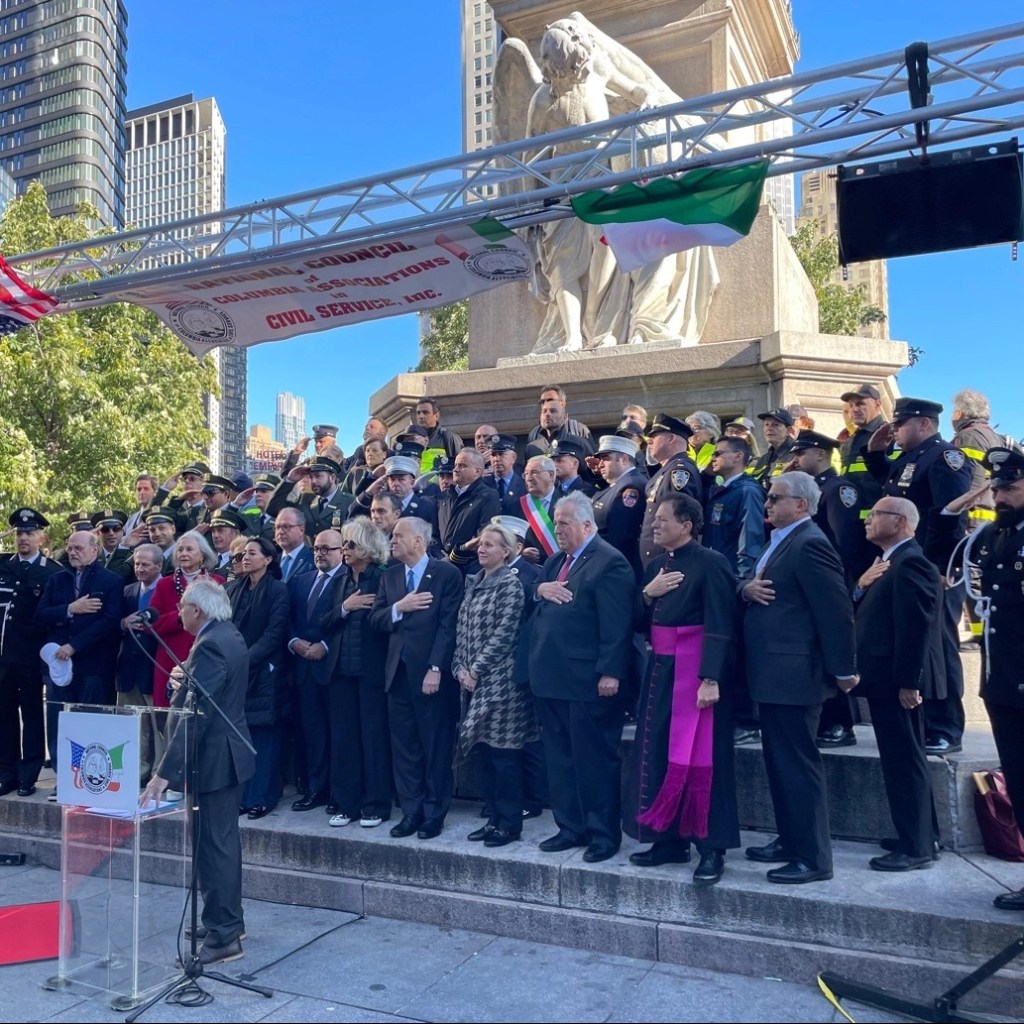
Columbus Wreath-Laying Ceremony at Columbus Circle
Other than a few policemen dotted around, Columbus Circle was practically empty at nine that Sunday morning. It was the first proper day of fall: the air felt frosty as the morning sun was shyly peering out from behind the skyscrapers.
Seated alone on a bench was Diana Falco, taking selfies with an Italian flag for her family back home in Chicago. She was one of the first guests to arrive at the wreath-laying ceremony, the first event to kick off this year’s Columbus Holiday. She had flown in the day before for this two-day event which includes a wreath-laying, a mass and a parade.
But Diana was here to see the statues.
“I miss them,” said Diana, who works as a purchasing agent at Bell Flavours & Fragrances; she had taken time off work to travel to New York from Chicago. In 2020, her city removed three statues that commemorated Columbus to protect public safety, following a series of demonstrations in which protesters tried to manually take down the statues. This change had prompted her to come celebrate Columbus Day here. “You can’t erase history; everybody should have their day.”
Diana grew up with her grandparents, who had migrated to the U.S from Naples in Southern Italy when her father was only eleven years old. “It was common for people to pop into the house,” Diana said, remembering her childhood home alive with Italian music and loud Neapolitan dialect, which was the first form of the Italian language she learnt.
When Diana’s family got to the United States in 1967, they were faced with all kinds of derogative names. Diana quickly became aware of the racial slurs used against Italian immigrants. “‘Wop’ was one of them. It means a greasy Italian,” she explains to me. Diana’s parents insisted she only speak Neapolitan dialect in the house, to avoid being bullied.
The Columbus statue was first placed here in 1892, to mark the four hundredth anniversary of Columbus’ arrival to the “new world”. Ten thousand people thronged to view the spectacle brought in from Italy. As the French historian Pierre Nora wrote in 1989, the statue represents an act of “rememoration” for the Italian American community, who wanted to keep what they see as a victorious colonial history alive.
Since that year, National Columbus Day has been celebrated annually every October. Founded to remember the death of eleven Italian Americans, lynched in a violent xenophobic attack in New Orleans that year, the day is a celebration of Italian American heritage and culture.
Although the crowd gathered today is much smaller, everyone is nonetheless paying their respects by wearing the country’s national colours. Football jerseys with iconic Italian players also made appearances.
At nine-thirty, the voice of Andrea Bocelli started blasting on the speakers. Red, white, and green balloons adorned the Columbus Statue, and people started filling up the steps to take their positions. Firefighters, policemen, mayors, priests, and members of various Italian American advocacy groups were all poised in front of the cameras, ready to begin the first celebration to kick off this year’s Columbus Holiday.
Despite the sense of excitement that morning, the people standing under Columbus were faced with a challenge: the statue could soon be taken down.
The week before, the New York City Council’s Committee on Cultural Affairs had set up a hearing to propose a new bill that would involve a plan to remove public statues on City property that commemorated a historical figure with direct ties to slavery. The committee has spent the last five years evaluating public statues and their relevance in the present-day context.
“The question becomes whether certain figures should be raised on a pedestal or not,” said historian Joseph Sciorra. Maintaining a statue with public funds continues to give significant prominence to the figure in question, whereas the narrative would change if it were moved into a museum where it would be seen as a historical artefact, Sciorra said.
City Council members seemed to be adamant to repair the harms done to Indigenous People through this proposed bill.
“We will always embrace inclusivity and equality in our work and reject hatred and oppression,” said Sreoshy Banarjea, the executive director of the Public Design Commission that oversees the management of the city’s design review procedures.
The Black Lives Matter Movement protests in 2020 ignited the conversation on the relevance of public statues after several were decapitated, spray-painted, and manually taken down across the country. The bill being proposed in New York City is a continuation of these conversations.
But Italian Americans at the wreath-laying seem to be ready to put up a fight. “Very few historical figures bear such a heavy burden of conflicting symbolism and narratives as Columbus,” said Fabrizio Di Michele, the Consul General of Italy in New York. “Somebody is suggesting that the Italian Americans, after 150 years, should change their symbol overnight, to not hurt other people’s feelings. Now, my question is, what about Italian Americans’ feelings?”
The crowd cheered.
Josephine Maietta, the president of the Association of Italian American Educators chimed in: “Every time I come to the statue, I say, ‘Ciao Columbus! Don’t worry about it, you’re not coming down!’”. The crowd sang both the Italian and American national anthems and patriotic zeal filled the air. At the end of the ceremony, Diana wanted to see the wreath closeup. She eagerly waiting in line until she got to shoot some final selfies with her new friend, Enrico Boletti, an Italian American member of the fire department.
Columbus Circle has always been a major intersection for New Yorkers as it is situated at the nexus of three neighbourhoods. Historically, it was considered the “North Pole” of the Broadway theatre world when they began building playhouses in the early 1900s, including the International Theatre.
Now the site is much different: yellow cabs wiz around, joggers emerge from Central Park’s southwest corner and suited-up businessmen disappear into 59th Street subway station. In 2022, over 13.7 million people took the subway here; Columbus Circle remains an integral landmark within Manhattan’s urban landscape.
But the hot topic of the Columbus Statue has expanded outside of New York City; the seaside town of Brookhaven in Long Island has taken matters into its own hands, offering to house the statue if it were to be removed. Over a quarter of Long Island’s population is Italian-American, more than any area outside of Italy. Brookhaven’s town Supervisor Edward Romaine appeared on Fox News on 21st September 2023, to voice the town’s support of the statue, stating: “They would welcome this opportunity.”
In the aftermath of World War Two, Italy found itself physically devastated following the fall of fascism. The United States opened its borders to Italian refugees, resulting in an influx of over three million immigrants at the turn of the century. Their arrival was met with disdain by many. According to historian Danielle Battisti, Italians were deemed “racially undesirable” and a less civilized European ethnic group. The figure of Columbus became fundamental to their quest for recognition as White during the twentieth century.
“Italian Americans began ascribing themselves to the history of quintessential American tropes” said Battisti. Columbus was venerated as one of the first pioneers, and some Italian Americans developed an emotional connection to this historic figure by projecting onto him their desire to prove they were just as American as ‘stock’ whites.
The following day and after she went to morning mass, Diana got ready for the second day of celebrations with the largest event: the Columbus Day Parade. She was joining the march with The Italian Sons and Daughters of America organization.From 39th Street every road was barricaded, and the sidewalks were packed with people taking their place along Fifth Avenue, as the performers got ready to march.
The gentle hum of the morning traffic was alleviated by the sound of bagpipe players, who were practicing in a corner before getting in formation. The white caps of the young marine corps could be seen from afar like droplets of foam within the ocean of spectators.
I stood next to Max on 47th street waiting for Diana to pass by. Max, a stocky-looking souvenir seller with a long wiry beard, was decked out from head to toe in tricolour clothing. He hadbeen there since nine, setting up his jittery table laden with merchandise: flags, umbrellas, hats, and funny pin badges that read “I’m not loud, I’m Italian”. “I get my pins made especially by my manufacturer,” he explains, pointing out some of his favourites. “They are one of a kind”.
This was Max’s third Columbus Day Parade, so he knows the gist of it now. The Parade is the largest one in the nation and goes on for five hours sometimes. Around thirty-five thousand people attended last year, including Italians who came from abroad especially for the occasion. The only celebration bigger than this is Saint Patrick’s Day.
Suddenly, the first band began the march, followed by members of the NYPD. The State Comptroller Thomas DiNapoli perched at the back of a vintage car, and then endless groups of children from the various Catholic schools of the state. A swarm of journalists rushed past following Mayor Adams, who’s small figure was quickly lost behind the cameras.
The most vivid opposition of the Columbus Parade was up north on Randall’s Island, three bus changes away from the commotion in Manhattan. Around twenty tents had been propped up and in the middle of the field was a bonfire with dancers and speakers. Over ten of the largest Indigenous advocacy groups had gathered here to celebrate their tribal heritages.
Courtney Streett and her husband John were among theparticipants. They run Native Roots Farm Foundation, a Delawarean non-profit that buys, restores and preserves land by growing native plants, including those that belong to the Nanticoke tribe that Courtney belongs to. Their mission is to provide the community with fresh produce, such as pawpaw, and educate them on their tribal histories that have almost entirely been eradicated by colonialism.
In an effort to empower Native American people during the celebrations of Columbus Day in New York City, Governor Cathy Hochul signed a proclamation in 2021, to acknowledge Indigenous People’s Day (IPD). However, because Columbus Day remains a federal holiday, IPD has not yet been fully legitimised by the City Council. “While it raises visibility of Indigenous people, tax dollars are implicated in Columbus Day and not all citizens agree,” said Roberto Mukaro Borrero, chief of the Guainía Taíno Tribe.
Participants on Randall’s Island believe that a legitimate remembrance day would be an effective way of stimulating conversation on the colonisation and genocide of Indigenous people. “Our community was not allowed to celebrate their traditions, so their stories were lost,” said Courtney. The Nanticoke people lost access to all their natural spaces used to make medicine and textiles. Only in 1968, were Indigenous people legally allowed to begin practicing their tribes’ rites again. “This weekend is about reclaiming what colonialism took away from us”.
“Our people are still here,” said Chenae Bullock, one of the organizers of IPD. Some members say they still suffer from the same discrimination as when Columbus first crossed the Atlantic, so it does not feel like a past history to them.
In 2018, Former Mayor de Blasio had set up the Commission on City Art and Monuments to address the controversies of the Columbus Statue. Roberto and his group, the United Confederation of Taíno People, engaged in discussions to incorporate Indigenous People’s history in an exhibition. But at the end of the year, Governor Andrew Cuomo unexpectedly added the Columbus statue to the National Register of Historic Places, legally making it near impossible for the statue to ever be taken down. “We entered this in good faith, but we were not included in this decision,” said Roberto.
Looking forward, although the conversations taking place are a positive step in the right direction, Roberto questionswhether the City Council votes will be enough to get the statue removed.
Every time he walks past the statue, Roberto is reminded of the genocide his own tribe faced by Columbus. Until it is gone, the statue continues to represent New York’s unwavering connection to the legacies of white supremacy.“If it is impacting another individual in a negative way, it is not a human right to have this statue,” said Roberto.
 Cecilia Blotto